Loading case study...
FinTech & Lending
AI Document Validation for Loan Processing
An AI-assisted document processing workflow that classifies, extracts, validates, and flags loan documents so operations teams can focus on exceptions instead of reviewing every file manually.
IndustryFinTech & Lending
ServiceAI & Automation, Product Engineering
ClientMortgage Lending Client
Timeline14 Weeks
Team size4 Engineers
70%
Less manual document review
98%
Extraction accuracy on supported document types
100%
Exceptions routed for human review
14 weeks
From discovery to production-ready workflow
The challenge
Manual document review was slowing down loan processing
The client’s operations team was handling a large volume of borrower documents across the lending workflow — identity documents, bank statements, income records, tax documents, property-related files, and other supporting evidence.
Each document had to be opened, identified, reviewed, and compared against the loan application before the case could move forward.
The process was repetitive and time-consuming. Information often appeared in different locations depending on the document type or source, and manual review made it difficult to maintain the same level of consistency across every application.
The client needed a way to automate routine document checks while ensuring uncertain, incomplete, or inconsistent cases were still reviewed by a person.
What we built
A document intelligence workflow that automates routine checks and escalates exceptions
We built an AI-assisted document-processing pipeline that receives uploaded loan documents, identifies the document type, extracts relevant information, and validates that information against application data and configurable business rules. The system was designed to handle common document variation while preserving human oversight. When extraction confidence is low, required information is missing, or inconsistencies are detected, the document is automatically flagged for manual review instead of passing silently through the workflow. The result is an exception-driven process where automation handles repetitive first-pass checks and operations teams can focus their attention on documents that genuinely require judgement.
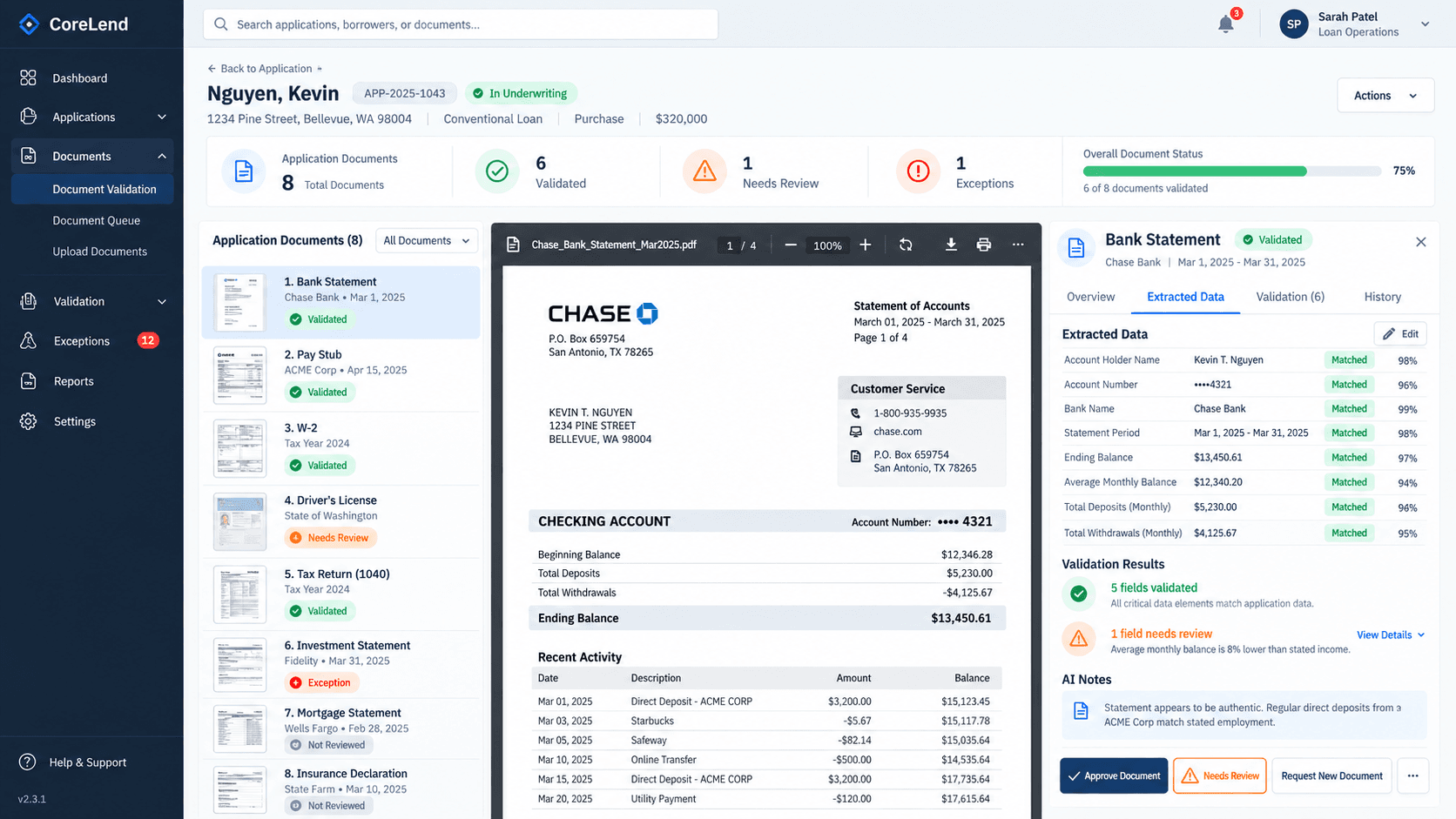
Document classification
Automatically identifies incoming files such as identity documents, bank statements, income documents, and other supporting records.
OCR & data extraction
Extracts relevant fields from documents and converts them into structured data that can be used by downstream workflows.
Technologies used
PythonOCR / Document AIPostgreSQLAWSREST APIs
The results
Faster document processing without removing human oversight
- Documents can be classified automatically as they enter the loan workflow.
- Relevant data is extracted into structured fields instead of being manually re-keyed.
- Extracted information can be validated against application records and business rules.
- Missing documents, inconsistent values, and low-confidence results are surfaced for review.
- Operations teams can focus on exceptions rather than manually reviewing every document.
- Validation actions and reviewer decisions remain traceable for audit and compliance purposes.
- Additional document types and validation rules can be added as lending requirements evolve.
Have a similar workflow to fix?
If manual review or a first-in-first-out process is slowing your team down, we'd be glad to talk through whether a similar approach could work for you.